
Weekly Mortgage & Market Update
This week’s data gives us a clearer snapshot of how the housing market and consumer economy are responding to falling mortgage rates and post-shutdown data releases. Home prices are still higher than a year ago, pending home sales hit their strongest pace of 2025, and the labor market continues to show signs of cooling beneath the surface. Here’s what stands out.
Home Prices Still Up Year-Over-Year, but Pace Slows
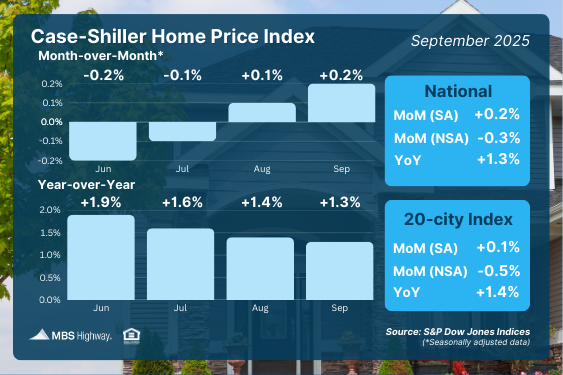
The Case-Shiller Home Price Index—one of the most widely watched measurements of U.S. home values—showed a 0.3% decline from August to September before seasonal adjustments, but a 0.2% increase after adjusting for seasonality. Year over year, national prices are still 1.3% higher, which is a slight dip from August’s 1.4% annual gain.
The FHFA Index, which tracks homes financed with conventional mortgages, showed no change month-to-month on a seasonally adjusted basis, while reporting a 1.7% annual increase.
Bottom line: prices remain above last year’s levels, but the rate of appreciation has cooled. If mortgage rates continue to fall, buyer demand could pick up further and potentially put upward pressure on prices again.
Pending Home Sales Rise in October
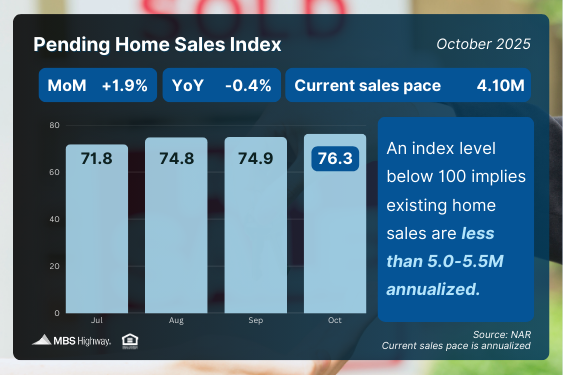
Pending Home Sales increased 1.9% from September to October, beating expectations and reaching their strongest level of the year, according to the National Association of REALTORS®. Contract signings were down only 0.4% from a year earlier.
Because pending home sales lead closings by one to two months, this rise suggests we should see more completed transactions heading into winter. Lower mortgage rates and improving inventory are clearly helping pull buyers back into the market.
Persistent Continuing Claims Highlight Slower Hiring
Initial jobless claims dropped by 6,000 to 216,000 — their lowest level in two months. But continuing claims, which measure the number of people still receiving benefits after their first week, rose by 7,000 to 1.96 million. That’s one of the highest levels in four years.
The continued rise in ongoing claims — which have stayed above 1.9 million since mid-May — indicates that workers who lose jobs are taking longer to find new ones. This is a clear sign that the labor market is cooling, even as layoffs remain relatively low.
September Retail Sales Show Shoppers Pulling Back
With delays from the shutdown now cleared, the government released September retail sales data. Sales rose 0.2%, which was below expectations and significantly lower than August’s 0.6% increase.
The “control group,” which excludes autos, gas, building materials, and food services (and feeds directly into GDP calculations), fell 0.1%. This was its first decline in five months.
Bottom line: retail spending softened in September, hinting that consumers were starting to pull back heading into the fourth quarter. The delayed October and November retail reports will tell us whether this is becoming a trend.
Energy Prices Fuel Rise in Wholesale Inflation
The government also released the delayed September Producer Price Index (PPI). Wholesale prices rose 0.3% from August and 2.7% year over year, largely due to a nearly 12% jump in gasoline prices.
Core producer prices, which exclude food and energy, increased 0.1% on the month and 2.6% year over year — both slightly below expectations.
This matters because wholesale prices feed directly into the Fed’s preferred inflation measure, the Personal Consumption Expenditures (PCE) index. While some shared PCE components rose (such as airline fares and nursing home care), others declined (including portfolio management and hospital outpatient services). Overall, this PPI report isn’t expected to cause a significant jump in the September PCE reading, now set for release on December 5.
Home Life Tip of the Week
With National Cookie Day coming up on December 4, this classic Sugar Cookie recipe from Food Network is a simple, festive way to celebrate — and it yields about four dozen cookies.
Preheat the oven to 375°F. In a small bowl, whisk together
2 3/4 cups all-purpose flour
1 teaspoon baking soda
1/2 teaspoon baking powder
In a large bowl, cream together
1 cup softened butter
1 1/2 cups sugar
Beat in 1 egg and 1 teaspoon vanilla, then slowly add the dry ingredients. Mix in 3 to 4 tablespoons of buttermilk to form a soft dough.
Shape the dough into small balls using rounded teaspoons and place on an ungreased baking sheet. Brush the tops lightly with buttermilk, flatten gently, and sprinkle with raw sugar or decorative sprinkles. Bake for 8–10 minutes or until edges are lightly golden. Cool on a wire rack.
What to Look for This Week
It’s jobs week — although the JOLTS data and the monthly Jobs Report remain delayed due to the shutdown. Here’s what will be released:
Wednesday: ADP’s November Employment Report
Thursday: Weekly Jobless Claims
Friday: The delayed September Personal Consumption Expenditures report, the Fed’s preferred inflation gauge
Technical Picture
Mortgage Bonds traded last week in a newly established range, finding support at 101.17 and resistance at 101.44. The 10-year Treasury yield continues to test the crucial 4% floor, and a firm move below it could send yields toward 3.95%.
Source: MBSHighway