
Weekly Mortgage & Market Update
Week of May 11, 2026 in Review
Inflation Picks Up, Complicating Rate Cut Outlook
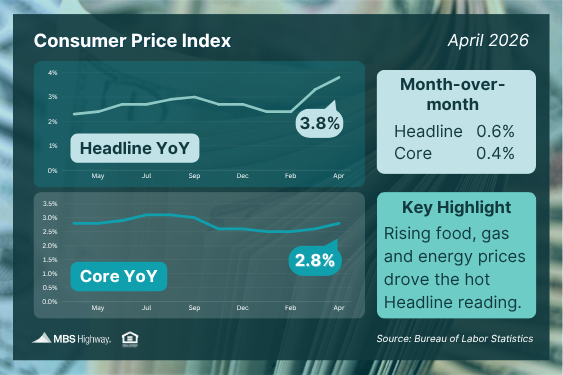
Inflation remained elevated in April, with the Consumer Price Index (CPI) rising 0.6% for the month and 3.8% year over year. Much of the increase was driven by higher gas and fuel prices tied to the Iran conflict, along with rising food costs. Together, food and energy accounted for more than half of the monthly increase in inflation.
Core inflation, which excludes food and energy, also came in hotter than expected, rising 0.4% in April and 2.8% annually. Wholesale inflation showed similar pressure, with the Producer Price Index (PPI) jumping 1.4% in April—nearly triple expectations—and rising 6% compared to a year ago, again driven largely by energy and gasoline costs. Core PPI increased 1% for the month and 5.2% annually.
The Federal Reserve continues to balance two competing trends: inflation that remains above target and signs that the labor market may be slowing. Persistent inflation supports keeping rates higher for longer, while weaker employment data could strengthen the case for rate cuts later this year. The Fed has kept its benchmark interest rate unchanged so far this year after cutting rates three times late last year. While the Fed does not directly set mortgage rates, its decisions strongly influence overall borrowing costs.
Meanwhile, the Senate confirmed Kevin Warsh as the next Chair of the Federal Reserve as Jerome Powell’s term came to an end. Markets will be closely watching Warsh’s first Fed meeting on June 16–17, along with any comments leading up to it, for signals on the future direction of rates.
Existing Home Sales Tick Higher in April
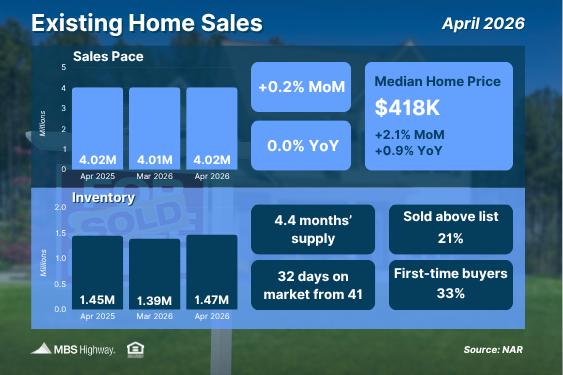
After declining in March, existing home sales rose slightly in April, increasing 0.2% according to the National Association of REALTORS®. Housing inventory also improved, rising 5.8% from March to 1.47 million homes, which is 1.4% higher than this time last year.
While inventory is moving in the right direction, the housing market remains undersupplied compared to historical norms. NAR Chief Economist Lawrence Yun noted that buyers are beginning to see a bit more breathing room, with bidding wars easing compared to recent years. He also pointed to improving affordability as one factor helping support home sales, despite mixed economic signals and weaker consumer confidence.
At a Glance: Consumer Spending and the Labor Market
Retail sales increased 0.5% in April, matching economists’ expectations. Excluding more volatile categories such as autos, gas, building materials, and restaurants, sales also rose 0.5%, which was stronger than expected. This “control group” measure is closely watched because it feeds directly into GDP calculations.
At the same time, higher fuel costs can still ripple through the economy by increasing transportation and operating expenses, which may be contributing to higher prices across other categories.
On the labor side, new unemployment claims remained relatively low at approximately 211,000. However, that number may not fully reflect labor market strain, as some displaced workers are turning to freelance or gig work instead of filing for benefits. Meanwhile, continuing unemployment claims remained elevated at 1.78 million, suggesting many job seekers are taking longer to secure new employment.
What to Look for This Week
Housing data will be the primary focus this week, beginning Monday with the latest builder confidence report from the National Association of Home Builders. On Tuesday, April’s Pending Home Sales report will be released, followed by new home construction data on Thursday.
Investors will also be watching Wednesday’s release of the Federal Reserve’s latest meeting minutes, which can sometimes influence market movement. In addition, updated Jobless Claims data will be released Thursday, providing another look at labor market conditions.
Technical Picture
Mortgage bonds ended last week sharply lower, breaking below several important support levels. They closed the week in a new trading range, with support near 99.59 and resistance at the 99.99 Fibonacci level.
Meanwhile, the 10-year Treasury yield moved above resistance at the 4.58% Fibonacci ceiling. With that key level now broken, the next area of resistance comes in around 4.65%.
Home Life Tip of the Week
It’s National Salad Month, making it a good time for an easy pasta salad that works well for lunch, dinner, or gatherings. This recipe serves 6 to 8.
Cook 1 pound of gemelli or another short twisted pasta in a large pot of salted boiling water until al dente. Drain, rinse under cold water to cool, and set aside. In a large bowl, whisk together 1 cup olive oil, 1/3 cup red wine vinegar, 2 teaspoons Dijon mustard, 1 tablespoon honey, 2 teaspoons salt, and 3/4 teaspoon pepper. Add the cooled pasta along with 4 Persian cucumbers (halved lengthwise and thinly sliced), 2 pints halved mini heirloom cherry tomatoes, 2 thinly sliced celery stalks, 2 cups thinly sliced radishes, 2 cups fresh corn kernels, 1 thinly sliced medium shallot, 1/2 cup chopped flat-leaf parsley, and 1/3 cup chopped dill. Toss until evenly coated, then let the salad sit at room temperature for at least 30 minutes so the flavors can blend, or refrigerate for up to 8 hours. Before serving, season with additional salt and pepper to taste and serve at room temperature.
SOURCE: MBSHighway