
Weekly Mortgage & Market Update
Week of August 31, 2026 in Review
August's jobs report was much stronger than expected, even as other data pointed to a cooling labor market.
August Jobs Report Surprises to the Upside
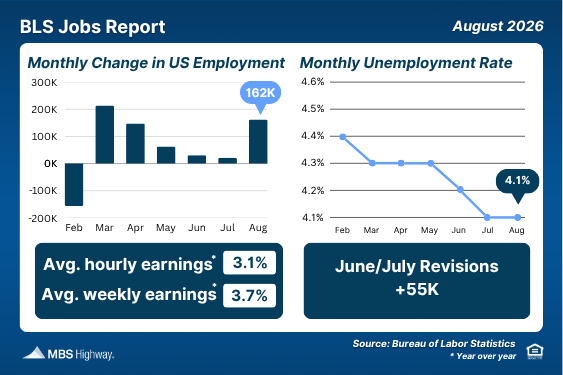
Monthly Change in US Employment
The economy added 162,000 jobs in August—nearly three times the expected gain. June and July payrolls were also revised higher by a combined 55,000 jobs. July's initial estimate of a 23,000-job loss was revised to a 21,000-job gain. The unemployment rate held steady at 4.1%
The underlying data was also strong. Full-time employment rose by 735,000, while part-time employment fell by 223,000. Leisure and hospitality added 62,000 jobs, and growth in the labor force helped keep unemployment at 4.1%.
However, monthly BLS figures can be volatile and subject to revision, and this report was notably stronger than other labor market measures, including ADP and Revelio Labs.
Private Sector Hiring Slows to Seven-Month Low
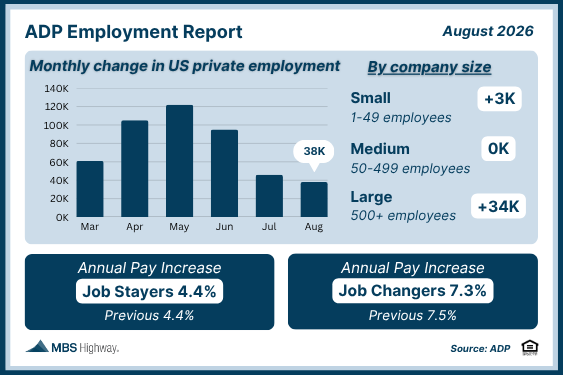
ADP Employment Rate
ADP reported just 38,000 private-sector jobs added in August, below expectations of approximately 50,000 and well below the BLS estimate of 127,000. This marked ADP's slowest pace of private-sector job growth since January.
Large businesses accounted for most hiring, while smaller employers added workers more slowly. Job switchers saw average pay growth of 7.3% over the past year, compared with 4.4% for workers who stayed with their employer.
Hiring remained concentrated, with education and health services accounting for much of the growth, rather than showing broad-based strength across the economy.
Other Reports Suggest the Labor Sector is Cooling
Revelio Labs reported 36,500 job gains in August, with health care and social assistance among the key drivers.
Job openings totaled 7.27 million in July, slightly below expectations of 7.3 million. June openings were also revised lower by 177,000 to 7.18 million. The number of unique opportunities may be somewhat lower because some remote jobs are posted in multiple locations.
Initial unemployment claims remained relatively low at approximately 206,000, while continuing claims stayed elevated at 1.78 million. This suggests layoffs remain limited, but workers who lose jobs may be taking longer to find new employment.
The mixed labor data comes as inflation remains above the Fed's 2% target. The Fed held rates steady in July, although three members favored a quarter-point hike. Fed Chair Kevin Warsh has kept a potential hike on the table if inflation doesn't improve, while Governor Christopher Waller and New York Fed President John Williams have indicated support for holding rates steady under current conditions.
Attention now turns to the August CPI report on September 11, an important data point ahead of the Fed's September 15–16 meeting.
Appreciation Forecasts Highlight Value of Homeownership
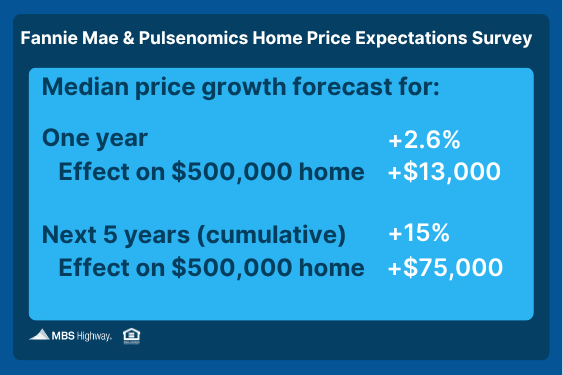
Home Price Expectation Survey
Fannie Mae and Pulsenomics' latest Home Price Expectations Survey, reflecting forecasts from more than 150 economists, real estate experts, and market strategists, projects median home price growth of approximately 2.6% over the next year and roughly 15% over five years.
For a $500,000 home, that equals approximately $13,000 in appreciation over the next 12 months and $75,000 over five years, highlighting the long-term wealth-building potential of homeownership.
Family Hack of the Week
Try these Homemade Granola Bars from Food Network for an easy breakfast or afternoon snack. The recipe makes 16 2-inch squares.
Preheat the oven to 350°F. Toast 2 cups rolled oats, ½ cup sunflower seeds, 1 cup sliced almonds, and ½ cup wheat germ for 15 minutes, stirring occasionally.
Meanwhile, heat ½ cup honey, ¼ cup dark brown sugar, 2 tablespoons butter, 2 teaspoons vanilla, and ½ teaspoon kosher salt until the sugar dissolves.
Reduce the oven to 300°F. Combine the oat and honey mixtures and stir in ¾ cup dried fruit. Press into a buttered 9-by-9-inch baking dish and bake for 25 minutes. Cool completely, cut into squares, and store in an airtight container for up to one week.
What to Watch Ahead
Following Monday's Labor Day market closure, Thursday brings Existing Home Sales, weekly jobless claims, and the Producer Price Index (PPI).
Friday brings the closely watched Consumer Price Index (CPI), providing another key look at inflation.
Source: MBSHighway